AI Therapy Notes: What to Consider Before You Record Sessions
Before adopting an AI note-taker, weigh consent, recording laws, HIPAA, data retention, accuracy, and cost per note. A practical guide for therapists.

Artificial intelligence (AI) therapy notes can save considerable time, particularly for clinicians who routinely end the day with unfinished progress notes. Emerging evidence suggests that ambient AI scribes can reduce documentation burden and after-hours work.1 But the benefits come with trade-offs, and those trade-offs are larger in mental health care: recording a confidential conversation, obtaining consent, storing and safeguarding audio and transcripts, checking AI-generated content for accuracy, and paying monthly subscription fees.2
For therapists, the question isn't whether AI notes are "good" or "bad." It's whether the time saved is worth those trade-offs in your practice and for your clients. Some clinicians will decide that it is. Others may prefer structured templates or snippets that reduce repetitive documentation without recording the session. Still others may use both. In this article, we break down the factors to weigh when deciding: AI or no AI.
Are AI note-takers worth it for therapists?
Emerging evidence suggests they can provide meaningful benefits, particularly by reducing documentation burden and allowing clinicians to devote more attention to clients.1 However, psychotherapy is an unusually sensitive application of ambient AI, and the therapist remains responsible for deciding what belongs in the clinical record, verifying accuracy, correcting errors, and protecting confidentiality. Whether the benefits outweigh the costs depends on:
- How you and your clients feel about recording;
- The legal requirements for AI recording where you practice;
- What the tool does with session data;
- How long recordings or transcripts are retained;
- How accurately it captures the session; and
- What it costs per note.
The evidence supports time savings, although most studies have involved physicians and other medical clinicians rather than psychotherapists. A 2025 multicenter study found improvements in documentation-related cognitive workload and after-hours documentation after 30 days of ambient AI use (AI that operates passively in the background).3 A 2026 study similarly found modest improvements in clinician productivity and efficiency.4 A 2025 randomized trial also demonstrated documentation-efficiency benefits with ambient AI scribes, along with potential reductions in clinician burnout, task load, and work exhaustion.5
Mental health deserves some extra caution when extrapolating those results. A 2026 scoping review found no empirical studies of AI scribes specifically in psychiatry among the literature it reviewed, highlighting an evidence gap.6 On the other hand, a recent observational study among mental health providers suggested that AI-powered documentation tools can support notetaking without compromising the quality of clinical notes.7
The consent issue
Depending on the AI documentation system, a session may be captured as audio, converted into a transcript, processed by another company, transformed into a draft note, and retained according to the vendor's data policies. That makes informed consent more complicated.
In a 2025 study examining consent for ambient AI documentation, 74.8% of participating patients reported being comfortable with their physician using ambient documentation.8 When given basic information, 81.6% consented; when information about AI functionality, data storage, and corporate involvement was added, that proportion fell to 55.3%. The investigators recommended transparent information, opportunities to ask questions, and clear opt-out mechanisms.8
For therapists, a plain-language consent discussion might therefore cover:
- What is being recorded or processed, and why the tool is being used;
- Whether a third party receives any information;
- Whether audio or transcripts are retained, and for how long;
- Who may have access to them; and
- What happens if the client declines.
Professional requirements also come into play. The American Psychological Association's Ethical Principles of Psychologists and Code of Conduct requires psychologists to obtain permission before recording clients and to discuss relevant limits of confidentiality.9 The American Counseling Association likewise requires counselors to obtain permission before recording sessions.10 The National Association of Social Workers' Standards for Technology in Social Work Practice also emphasizes informed consent when technology is used to gather, manage, or store client information.11
Privacy and legal requirements
Professional standards must be applied alongside the law. In the United States (US), AI-assisted notetaking in clinical practice is primarily governed by federal health privacy regulations, state recording-consent statutes, and rules requiring clinician oversight.12
At the federal level, the Health Insurance Portability and Accountability Act (HIPAA) is the primary authority. HIPAA protects client health data, and AI tools that process these data must meet HIPAA security standards. Systems must use encryption, access controls, and audit logs that track who views electronic notes.13 HIPAA also requires a Business Associate Agreement (BAA): the AI vendor must sign a legal contract agreeing to protect client data under HIPAA rules.
Recording-consent requirements differ among states, and some states add their own health privacy rules on top of HIPAA. Before recording, check your current state law, licensing-board requirements, professional ethics code, organizational policies, and applicable federal requirements.
Do the math: subscription price vs time saved
A monthly price by itself tells you little about whether an AI scribe is worth paying for. A more useful figure is cost per note:
Then compare that amount with the documentation time actually saved. For example, suppose a hypothetical service costs $100 per month, and you use it for 100 sessions per month. That works out to $1 per note. If it saves an average of 5 minutes on each note, that represents roughly 500 minutes (about 8.3 hours) of documentation time each month, or about $12 per hour saved.
Also count the time spent reviewing the output. Psychiatric literature specifically identifies accuracy, privacy, and the ability of a scribe to capture nuanced communication as concerns, so a generated note should be treated as a draft requiring clinical review rather than an authoritative record.2 The real calculation is therefore:
If careful review takes 4 of the 5 minutes the scribe saved, the same $100 subscription now buys about 1.7 hours a month, or roughly $60 per hour saved.
The alongside pattern: snippets
Clinicians often have language and formats that should stay predictable and under their control: the explanation they use when requesting consent, their preferred descriptive words or phrases, the instructions they give a scribe, and reminders about what belongs in a particular note section. Those are good candidates for reusable snippets.
Clinicians can make (or download) templates for their notes, referral letters, consent forms, and other documents. These are the clinician's own saved text, and they work with or without a scribe. Standard intro paragraphs and phrases can be inserted with a short keyboard shortcut instead of being typed or dictated in full each time.
A ready-made Text Blaze pack is a collection of snippets you can add in one click. For example:
- Therapy Intake & Consent Forms: editable informed-consent snippets, including AI-use consent language;
- Therapy Progress Note Templates (SOAP, DAP, BIRP): structured note formats you can fill in quickly (see our guide to therapy progress note templates).
The same approach works for the instructions a clinician gives a scribe and the phrases they use to edit its draft. That distinction matters: snippets don't transcribe a therapy session or generate its clinical content. They keep the clinician's wording and structure available when needed, which saves time and keeps documentation consistent.
Want to write your notes faster?
Join over 800,000+ others who are using Text Blaze templates.
Deterministic vs generative AI: when a template beats a transcript
Deterministic and generative are two distinct approaches to documentation.
Generative (the transcript): Speech recognition plus large language models turn the clinician-client conversation into a narrative clinical note. This provides flexibility: the AI can summarize, reorganize, and synthesize a lengthy session.
Deterministic (the template): A deterministic or rules-based system works within predefined fields, templates, decision rules, or structured prompts. Given the same inputs, its behavior is comparatively predictable.
Mental health documentation makes this distinction particularly important. AI scribes may struggle with contextual and interpretive subtleties, and emerging research suggests that generative documentation may change what information appears in the record. A 2026 study of more than 20,000 primary-care notes found greater documentation of neuropsychiatric symptoms in ambient-AI-scribed notes, while psychiatric interventions were documented less often than in notes written without a scribe.14
A structured, template-based approach may have advantages when documentation depends on a defined set of clinically important variables. For psychotherapy, this might mean documenting predefined elements such as presenting concern, symptoms, mental status, interventions, risk assessment, response to treatment, and plan. These can be narrowed further to include other standard variables, such as suicide/self-harm risk, mental-status findings, treatment interventions, medication adherence, functional change, progress toward treatment goals, or follow-up plans.
Templates have weaknesses too. Psychotherapy doesn't always fit neatly into boxes, and a highly deterministic system may omit unexpected but important information simply because no appropriate field exists. Generative AI can potentially preserve relationships among symptoms, life events, treatment response, psychosocial circumstances, and the therapist's interventions.
In short, generative AI is well suited to summarizing, organizing, and converting conversational information into readable text. Templates are better suited to ensuring that required information is explicitly addressed and that important clinical domains aren't left out.
A decision checklist before adopting AI therapy notes
Before choosing an AI scribe, consider the following questions:
- Consent: What will I tell clients, and how will I document their choice?
- Recording: Is audio captured, and what do my state law and professional codes require?
- Data flow: Who processes the audio or transcript, where does the information go, and who can access it?
- Retention: Will the audio or transcript be retained? If so, for how long, and what happens when it's deleted?
- Privacy: If protected health information is processed by an outside service, will the vendor sign a BAA, and what other legal and contractual requirements apply?
- Accuracy: How will I review every generated note?
- Format: Can the system reliably produce the documentation structure my practice or payer requires?
- Economics: What is my cost per completed note after accounting for review and editing time?
- Opt-out: What is my documentation workflow when a client declines recording or AI processing?
- Fallback: If the AI system is unavailable, can I still document efficiently without it?
Frequently asked questions
Do I need client consent to use an AI scribe in therapy?
In practice, yes. The APA and ACA ethics codes require permission before recording clients, and many state laws require consent to record a conversation. Consent is most meaningful when clients know what is recorded, who processes it, how long it's kept, and what happens if they say no.
Is an AI scribe HIPAA compliant?
It depends on the vendor and how it's configured. At a minimum, the vendor should sign a Business Associate Agreement and use encryption, access controls, and audit logs. A BAA alone doesn't make a tool compliant, so review the vendor's data flow and retention policies too.
Can I use templates with an AI scribe?
Yes. Templates and snippets can define the structure of the note, hold your consent language, and store the instructions you give the scribe. They work the same way whether or not a scribe drafts the content.
Are AI-generated therapy notes accurate?
They can be useful drafts, but they're not authoritative records. Research suggests AI scribes can change what gets documented, so every generated note needs clinical review before it enters the record.
Keep your documentation under your control
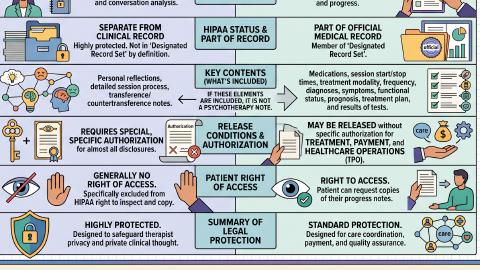
Whether or not you adopt an AI scribe, your consent language, note structure, and go-to phrases should be reusable and consistent. Text Blaze for therapists puts ready-made templates for intake, consent, and progress notes behind a keyboard shortcut, in any EHR or web app. For what belongs in the clinical record versus private notes, see psychotherapy notes vs. progress notes.
Want to write your notes faster?
Join over 800,000+ others who are using Text Blaze templates.
Bokhari SA, Nawaz FA, Usman FM, et al. Clinician and simulated patient perspectives on ambient AI scribes in psychiatric consultations: A qualitative study. Front Psychiatry. 2026;17:1821065. doi:10.3389/fpsyt.2026.1821065 ↩︎
Buckley P, Wang Y, Gopalan P. Artificial intelligence scribes in psychiatry. Focus (Am Psychiatr Publ). 2025;23(1):44-48. doi:10.1176/appi.focus.20240024 ↩︎
Olson KD, Meeker D, Troup M, et al. Use of ambient AI scribes to reduce administrative burden and professional burnout. JAMA Netw Open. 2025;8(10):e2534976. doi:10.1001/jamanetworkopen.2025.34976 ↩︎
Husa RA, Haggerty J, Nute AW, et al. Ambient artificial intelligence use and clinician documentation burden, productivity, and efficiency. JAMA Netw Open. 2026;9(5):e2615762. doi:10.1001/jamanetworkopen.2026.15762 ↩︎
Lukac PJ, Turner W, Vangala S, et al. Ambient AI scribes in clinical practice: A randomized trial. NEJM AI. 2025;2(12). doi:10.1056/AIoa2501000 ↩︎
Daignault C, Audelin-Rinfret J, Désilets M, et al. The use of AI scribes across medical fields and why psychiatry is lagging behind: A scoping review. Sante Ment Que. 2026;51(2):53-83. www.revue-smq.ca/the-use-of-ai-scribes-across-medical-fields-and-why-psychiatry-is-lagging-behind-a-scoping-review/ ↩︎
McCrudden KE, Swirbul MS, Peake EE, et al. AI-powered documentation for mental health providers: Retrospective observational mixed methods study. JMIR Form Res. 2026;10:e84628. doi:10.2196/84628 ↩︎
Lawrence K, Kuram VS, Levine DL, et al. Informed consent for ambient documentation using generative AI in ambulatory care. JAMA Netw Open. 2025;8(7):e2522400. doi:10.1001/jamanetworkopen.2025.22400 ↩︎
American Psychological Association. Ethical principles of psychologists and code of conduct. American Psychological Association website. Updated January 1, 2017. Accessed September 17, 2026. www.apa.org/ethics/code ↩︎
American Counseling Association. 2014 ACA Code of Ethics. Alexandria, VA: American Counseling Association; 2014. www.counseling.org/docs/default-source/default-document-library/ethics/2014-aca-code-of-ethics.pdf ↩︎
National Association of Social Workers, Association of Social Work Boards, Council on Social Work Education, Clinical Social Work Association. Standards for Technology in Social Work Practice. Washington, DC: National Association of Social Workers; 2017. ↩︎
Pham T. Ethical and legal considerations in healthcare AI: Innovation and policy for safe and fair use. R Soc Open Sci. 2025;12(5):241873. doi:10.1098/rsos.241873 ↩︎
Alder S. HIPAA, healthcare data, and artificial intelligence. The HIPAA Journal. 2026. www.hipaajournal.com/hipaa-healthcare-data-and-artificial-intelligence/ ↩︎
Castro VM, McCoy TH, Verhaak P, et al. Psychiatric documentation and management in primary care with artificial intelligence scribe use. JAMA Psychiatry. 2026;83(3):281-286. doi:10.1001/jamapsychiatry.2025.4303 ↩︎