IEP Goal Bank for SLPs and OTs: How to Use One Without Writing the Same Goal Twice
Learn how SLPs and OTs can turn IEP goal banks into reusable goal frames that stay measurable, individual, and defensible, with example frames for each area.

An IEP goal bank is goal wording you reuse and adapt, so you aren't writing every IEP goal from a blank page. That's all it is. Most of the ones in circulation aren't products at all. They're documents: a few hundred goals in a shared file, often an IEP goal bank PDF, passed from one SLP or OT to the next.
That's how it actually works, and there's nothing wrong with it. SLPs hand each other hundreds of goals at a time, and they're clear about what they're for: a framework to build from, not a list to pick from. You read a few that are close, keep the structure that works, and write the goal for the student in front of you. Starting from someone else's wording isn't lazy. Stopping there is.
How do school OTs and SLPs keep up with IEP paperwork?
They don't start from a blank page. They reuse goal and present-levels wording they trust, keep data in one place rather than three, and write progress reports from that data instead of reconstructing it each time. The wording repeats. The student's numbers don't.
None of that fixes a caseload. Caseloads and district rules vary enormously, and plenty of SLPs and OTs still write IEPs on their own time. What it changes is how long the writing itself takes.
Measurable, individual, defensible: the three tests a reused goal must pass
A goal you started from someone else's IEP goal bank still has to stand on its own. Three tests:
Measurable. A skill, a criterion (a percentage or a number of trials), and a cue level if you're an SLP or an assist level if you're an OT. A working check: if two people read the goal and could disagree about whether the student met it, it isn't measurable yet.
Individual. Tied to this student's present levels. Not a goal that came along because it was sitting nearby in the document.
Defensible. A parent or an administrator can read it and see why it's there.
Two of those three aren't matters of taste. 34 CFR 300.320(a)(2) calls for "a statement of measurable annual goals," and requires those goals to meet "the child's needs that result from the child's disability." Measurable is the regulation's own word. So, in substance, is individual.
Which is why the cookie-cutter complaint isn't really about style. SLPs describe seeing goals written for skills a student hasn't been taught the groundwork for, a problem-solving target for a student still working on basic concepts. A goal like that fails the second test as a matter of regulation and not just judgment. It doesn't meet a need that results from that student's disability. It meets a need the document had.
Want to stop retyping the same goal?
Join 800,000+ who are using Text Blaze templates.
Speech-language goal areas and example frames
A frame is a goal with the changing parts left open. One for each of the areas you write most:
Articulation
Articulation goal
{formtext: name=Student} will produce /{formtext: name=sound}/ in {formmenu: initial; medial; final} position at the {formmenu: word; phrase; sentence} level with {formtext: name=accuracy}% accuracy across {formtext: name=number} of {formtext: name=total} data opportunities, with {formmenu: no; minimal; moderate; maximal} verbal or visual cues.
_
Receptive and expressive language
Language goal
{formtext: name=Student} will {formmenu: follow two-step directions; answer wh- questions; retell a short narrative; use a target grammatical form} in {formmenu: structured; conversational} contexts with {formtext: name=accuracy}% accuracy across {formtext: name=number} of {formtext: name=total} data opportunities, given {formtext: name=cue level} cues.
_
Fluency
Fluency goal
{formtext: name=Student} will use {formtext: name=target strategy} during {formmenu: structured conversation; a classroom presentation; small group} in {formtext: name=percentage}% of observed speaking opportunities, given {formtext: name=cue level} cues.
_
Pragmatics and social communication
Pragmatics goal
{formtext: name=Student} will {formmenu: initiate a topic; maintain a topic across three or more exchanges; repair a communication breakdown} in {formtext: name=setting} across {formtext: name=number} of {formtext: name=total} data opportunities, given {formtext: name=cue level} cues.
_
AAC
AAC goal
{formtext: name=Student} will use their AAC system to {formmenu: request; comment; protest; greet} across {formtext: name=number of settings} settings in {formtext: name=number} of {formtext: name=total} data opportunities, given aided language modeling.
_
The boxes are what changes from student to student. Everything outside them is what you get right once. That's the structure that makes the goal measurable, with a box for a skill, a criterion, a number of opportunities, and the level of support. Write those four well and the frame holds up for the next student who needs it. The target, the percentage and the cue level are still that student's.
OT goal areas and example frames
If you're a school or pediatric OT, this is your half of the post, and it isn't the speech section with the nouns swapped. Different areas, different frames, and one difference that matters more than the rest: your goals carry an assist level, not a cue level.
Most OTs already have a frame for this. COAST is five elements:
- Client: who is performing
- Occupation: what occupation
- Assist level: with what level of assistance or independence
- Specific condition: under what conditions
- Timeline: by when
Worth knowing, because it gets missed: those five don't have to appear in that order. Gateley and Borcherding's Documentation Manual for Occupational Therapy says so directly. As long as all five elements are there, you can lead with the condition, or the occupation, or the timeline. Which is more useful than it sounds, because a set of goals that all open with "Client will" reads like a form someone filled out rather than a plan someone wrote.
So, the shape:
COAST
COAST goal
{formtext: name=Student} will {formtext: name=occupation} with {formtext: name=assist level} under {formtext: name=specific condition} by {formtext: name=date}.
_
And the areas you write most:
Fine motor and handwriting
Fine motor goal
{formtext: name=Student} will {formmenu: form lowercase letters; copy from the board; cut along a curved line; manage a zipper} with {formtext: name=assist level} during {formtext: name=classroom activity} in {formtext: name=number} of {formtext: name=total} trials by {formtext: name=date}.
_
Self-care
Self-care goal
{formtext: name=Student} will {formmenu: don a coat; open lunch containers; complete the toileting routine} with {formtext: name=assist level} in the school setting in {formtext: name=number} of {formtext: name=total} opportunities by {formtext: name=date}.
_
Sensory regulation
Sensory regulation goal
{formtext: name=Student} will {formmenu: use a self-selected regulation strategy; request a break} with {formtext: name=assist level} when {formmenu: presented with a non-preferred task; transitioning between activities} in {formtext: name=number} of {formtext: name=total} opportunities by {formtext: name=date}.
_
School participation
School participation goal
{formtext: name=Student} will {formmenu: sustain seated attention for 10 minutes; retrieve and organize materials; participate in a small-group activity} with {formtext: name=assist level} during {formtext: name=routine} in {formtext: name=number} of {formtext: name=total} opportunities by {formtext: name=date}.
_
Two small things that save editing later. The box you fill most often is the assist level, and the range is usually some version of independent, setup, supervision, minimal, moderate, maximal. Pick your district's wording once and keep it. And COAST says client, while the IEP says student. Every school OT swaps that word without thinking about it, which is exactly why the frame you save should already have it right.
From IEP goal bank to goal frames: the student's data as fields
Here's the step most goal banks skip. A goal you have reused three times is already a frame. You just haven't saved it as one.
Watch what you actually do with it. You open the file, scroll to the goal that's closest, copy it, paste it into the IEP, then edit four things: the student's name, the target skill, the criterion, and the cue or assist level. The wording in between doesn't change, because that part you already got right.
Which works, until you miss one. Anyone who has written IEPs out of a shared document has at some point left last year's student named in a goal, or a criterion that belonged to somebody else. Copy and paste doesn't tell you when you've forgotten a field.
There's a quieter version of the same problem. The document you inherited came with whatever was in it, and that often means real names and real scores from whoever handed it over. A frame holds none of that. The wording is what gets saved. The data gets typed in when you use it.
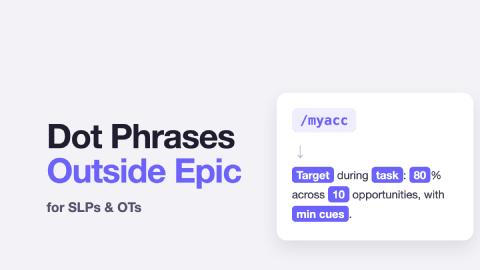
So save the goal as a frame instead of a paragraph. Text Blaze is a free browser extension for Chrome and Edge, with desktop apps for Windows and Mac. In it, that looks like this: once you've added the free Speech Therapy Goal Bank & IEP Present Levels, you type /artgoal in the field you're already writing in, and the articulation frame comes up with boxes for the student's name, the target sound, the criterion and the cue level. OTs who add the OT Goal Bank: COAST and SMART Goals by Setting can do the same with /coast, with the occupation and the assist level as boxes. You fill the boxes. Nothing fills itself in.
It works in your IEP program's web page, in Google Docs and in Word, which covers most of where this writing actually happens. Some locked-down systems block it, so it's worth a two-minute test in your own IEP program before you build out a whole set.
The structure repeats. The data is that student's, every time. That's why the fortieth goal of the season doesn't have to take the time the first one took.
Progress reporting from the goals you wrote
Progress reports are where goal wording comes back around, and that's the part nobody plans for. You wrote the goal in September. In January you have to say whether the student is meeting it, and the sentence you write to say so has the same four moving parts every time: the goal, the data, the criterion, and whether progress is sufficient.
One habit worth stealing. School SLPs describe taking data every session and keeping the last three data points per goal in a spreadsheet, so progress reporting becomes a matter of reading a row instead of reconstructing a semester. The spreadsheet isn't the clever part. Having the numbers in one place before you open the report is.
With those numbers in front of you, the progress sentence is a frame like any other:
Progress report sentence
{formtext: name=Student} demonstrated {formtext: name=skill} with an average of {formtext: name=average}% accuracy across {formtext: name=number} data points this reporting period, compared with a baseline of {formtext: name=baseline}%. Progress is {formmenu: sufficient; insufficient} toward the annual goal.
_
Every blank, filled from the row.
None of this touches the thing that actually hurts. One second-year school SLP described keeping a running tally of the assessments and IEPs written entirely outside contract hours, and watching it climb. A frame doesn't fix that, and nothing in a blog post will. What it changes is narrower: the hour you spend on a progress report goes to the student's numbers rather than to rebuilding the sentence that holds them.
Where to get a free IEP goal bank
Both of these are free, they install in one click, and you can edit every snippet in them once they're in your account.
For SLPs: Speech Therapy Goal Bank & IEP Present Levels. Eleven snippets. Goal frames for articulation, language, fluency, pragmatics and AAC, a present-levels opener, a progress report sentence, and the small pieces you reuse constantly like the criterion clause and the cue hierarchy. Each one has fields for that student's data. Start with /plp, the present levels opener, because present levels are usually the blank page you're staring at first.
For OTs: OT Goal Bank: COAST and SMART Goals by Setting. Ten snippets, organized by setting rather than by diagnosis, covering pediatric and school caseloads, plus skilled nursing and a feeding goal, in COAST and SMART formats, with fields for the task, the assist level and the timeframe. Start with /coast.
Install the free IEP goal bank for speech or OT, write one goal with it, and see whether the next one feels different.