What Is Text Replacement? How to Set It Up on Every Device (2026)
Text replacement expands short shortcuts into full phrases. Learn what it is, how it works, and how to set it up on Windows, Mac, Android, and iPhone.

Text replacement turns repetitive typing into a few keystrokes. Whether you're typing the same email signature, mailing address, or customer support reply dozens of times a day, you can set up a shortcut that automatically expands into the full text, saving time and reducing typos.
It's built into macOS, iOS, and Android, partially supported on Windows, and available system-wide on any device through dedicated text replacement tools that work across browsers, desktop apps, and websites.
In this guide, you'll learn what text replacement is, how it works, how it compares to similar features like autocorrect and autofill, and how to set it up on every major device, plus how to use it anywhere you type with a free cross-platform tool.
What Is Text Replacement?
Text replacement is a built-in feature on most modern devices that turns a short shortcut, like /sig or addr, into a longer phrase, sentence, or template automatically. You define the shortcut once, and from then on typing it instantly expands into the full text you assigned.
It's a built-in feature and typing hack for macOS, iOS, and Android. On Windows and across the web, it's available system-wide through dedicated text expander tools.
The same concept goes by several names depending on the platform or tool:
Text replacement — Apple's term, used on macOS and iOS
Text shortcuts — common on Android and in some keyboards
Text snippets — used by tools like HubSpot and Gmail
Text expansion — used by dedicated tools like Text Blaze, TextExpander, and Magical
All of these refer to the same core idea: turning a short trigger into longer text automatically.
How Text Replacement Works
Text replacement works by linking a shortcut (also called a trigger or abbreviation) to a longer piece of text. The process has four steps:
Create a shortcut. Choose a short combination of letters (typically 2-6 characters) like
/sigoraddr.Assign the full text. Link that shortcut to a longer phrase, sentence, or template.
Type the shortcut. When you type the shortcut in a supported app or field, the system recognizes it.
Automatic expansion. The shortcut instantly expands into the full text — no copy-pasting required.
Once set up, the expansion happens automatically every time you type the shortcut. Depending on the tool, expansion can be triggered after you press space, after you type a punctuation mark, or after a specific trigger character like /.
Common Uses for Text Replacement
Text replacement is most useful for content you type frequently and word-for-word. The most common starting point is personal information: your email signature (often triggered by sig), your full email address, your phone number, or your mailing address (addr). These are the shortcuts most people set up first because they save time across nearly every kind of typing.
From there, the highest-leverage use is in work communication, especially for anyone who sends similar replies all day. A customer support rep might use ack for "Thanks for reaching out, I'll look into this and get back to you shortly," esc to escalate a ticket, and mtg to confirm a meeting time. Each shortcut might only save 5-10 seconds, but across 50 or 100 messages a day, that compounds into real time back.
As a general rule, if you type the same thing more than 3-5 times a week, it's worth setting up a shortcut.
Why Text Replacement Saves Time
A few seconds saved per shortcut adds up faster than most people expect. Someone who sends 30 emails a day and uses text replacement for their signature, common greetings, and three or four standard responses can easily save 15-30 minutes per day (the equivalent of 60-120 working hours per year).
Beyond raw time savings, text replacement also reduces typos and inconsistencies, speeds up onboarding for support and sales teams, and lowers cognitive load (you stop thinking about how to phrase routine responses and focus on the parts of your work that actually need thought).
The more repetitive typing in your workflow, the bigger the payoff.
Text Replacement vs. Autocorrect, Autofill, and Predictive Text
Text replacement is often confused with related typing features that work differently. Here's how it compares to the three most common alternatives, and when to use each.
Text Replacement vs. Autocorrect
Autocorrect automatically fixes typos and misspellings as you type ("teh" becomes "the"). It runs on a built-in dictionary and isn't customizable in most apps. The system decides when to intervene, and it's trying to catch mistakes.
Text replacement is explicit and customizable: you define the shortcut, and you define the expansion. Autocorrect guesses what you meant; text replacement does exactly what you told it to. They can run alongside each other — autocorrect catches typos, text replacement handles the phrases you intentionally want to expand.
Text Replacement vs. Autofill
Autofill automatically populates form fields with saved data: names, addresses, credit card numbers, passwords. It works inside browser form fields and is triggered by clicking on a field, not by typing.
Text replacement works anywhere you type, not just in form fields, and is triggered by typing a shortcut. Both can save time on repetitive data entry, but they apply to different contexts: autofill is for forms, text replacement is for everything else.
Want to use text replacement on any site or app?
Join 800,000+ who are using Text Blaze for text replacement.
Text Replacement vs. Predictive Text
Predictive text suggests the next word or phrase based on what you've already typed. You see suggestions and tap or click to accept them.
Text replacement is deterministic, not suggestive — there's no guessing. When you type the shortcut, you always get the same expansion. Predictive text is helpful for casual mobile typing; text replacement is faster and more reliable for content you type repeatedly and word-for-word.
Quick Comparison
| Feature | Text Replacement | Autocorrect | Autofill | Predictive Text |
|---|---|---|---|---|
| Customizable by user | ✅ | ❌ | Partial | ❌ |
| Triggered by typing a shortcut | ✅ | ❌ | ❌ | ❌ |
| Works in form fields | ✅ | ✅ | ✅ | ✅ |
| Works anywhere you type | ✅ | ✅ | ❌ | ✅ |
| Deterministic (same input → same output) | ✅ | Partial | ✅ | ❌ |
| Supports multi-line templates | ✅ | ❌ | ❌ | ❌ |
| Cross-device syncing | Partial | ✅ | ✅ | ✅ |
These tools aren't mutually exclusive. Many people use all four together: autocorrect catches typos, autofill handles forms, predictive text speeds up mobile typing, and text replacement handles the longer phrases and templates that show up in their daily work.
How to Set Up Text Replacement on Each Device
Setting up text replacement is straightforward on most devices. Here's how to enable it on Mac, Windows, Android, and iPhone.
Text Replacement on Mac
macOS includes built-in text replacement that works across most native apps that use the default Apple keyboard.
Here's how you can set up text replacement on your Mac:
Once added, your shortcut will automatically expand into the full text in supported apps.
Note: macOS text replacement works well for simple shortcuts. If you need advanced templates, dynamic fields, or cross-platform syncing, you'll need a dedicated text expansion tool.
Text Replacement on Windows
Windows does not offer system-wide text replacement natively. Windows 11 typing settings include autocorrect for misspelled words — but not shortcut triggers.
Some Microsoft apps, such as Word, include an AutoCorrect feature that works similarly to text replacement. However, this only applies within that specific app and doesn't work across your entire system.
If you want text replacement that works across browsers, email apps, forms, and other desktop programs, you'll need a dedicated text replacement tool.
Note: If you're looking for cross-platform text replacement that works in any app or website, read on about Text Blaze.
Text Replacement on Android
Most Android devices support text replacement through the keyboard’s Personal Dictionary or Text Shortcuts feature.
Note that the exact steps may vary slightly depending on your device and keyboard app.
After saving, typing your shortcut will expand into the full phrase in supported apps.
Note: Android text replacement is best for basic shortcuts. Customization and advanced template options are limited compared to dedicated tools.
Text Replacement on iPhone
iOS includes built-in text replacement that works in most apps using the default iPhone keyboard.
Here's how to set up text replacement on your iPhone:
Once saved, typing your shortcut will automatically expand into the full phrase.
Note: iOS text replacement works across most apps but offers limited customization. For advanced templates or cross-device syncing, a dedicated text expansion tool may be a better fit.
How to Set Up Text Replacement on Any Site or App
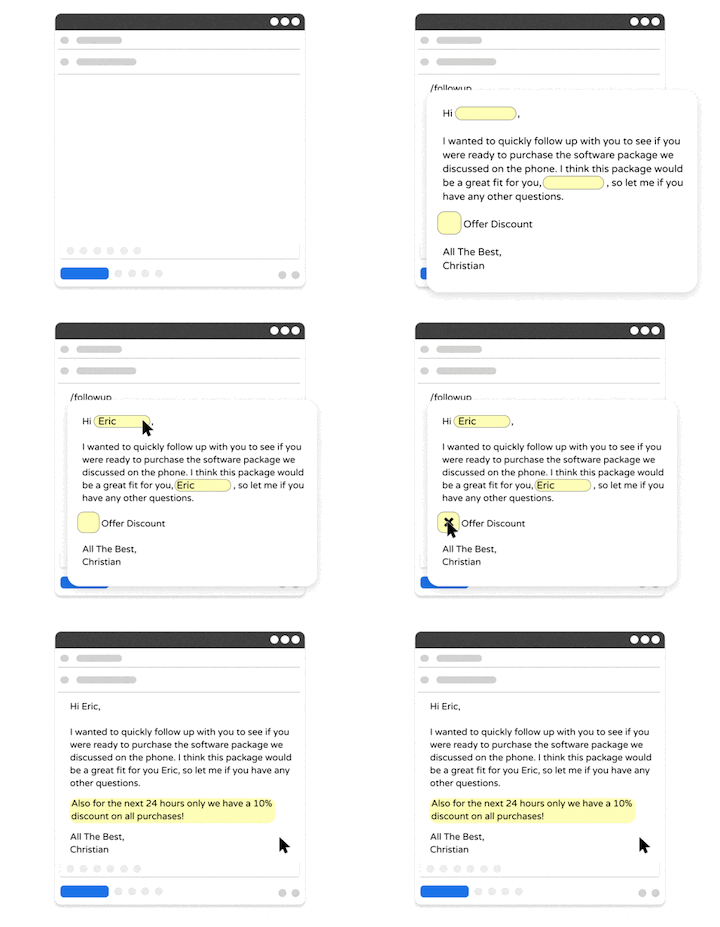
Built-in text replacement is fine for simple shortcuts on Mac, iPhone, and Android. But it doesn't work system-wide on Windows, doesn't sync between platforms, and doesn't support dynamic templates with placeholders or logic.
Text Blaze solves all three. It's a free text replacement tool that works as a Chrome extension, Edge extension, Windows app, and Mac app, so the same shortcuts work everywhere you type, with simple shortcuts or dynamic templates that include placeholders, dates, and conditional logic.
Here's what makes Text Blaze different from built-in text replacement:
Automate repetitive typing using text replacement and keyboard shortcuts.
Works on any site or app via the Text Blaze Chrome Extension, Windows app, Mac app, and Edge extension!
Free forever! No licenses or 7-day trials needed!
#1 rated productivity extension on the Chrome Web Store with 1,800+ 5 star reviews and a 4.9 overall rating.
Create dynamic text templates using placeholders, dynamic logic, and more!
Want to use text replacement on any site or app?
Join 800,000+ who are using Text Blaze for text replacement.
Text Replacement List + Examples
Text replacement works best when applied to phrases and templates you repeat frequently. Here are practical shortcuts you can adapt right away:
Personal Information
Quick shortcuts for details you regularly enter into forms, emails, and accounts:
addr→ 123 Main St, Springfield, IL 62701phone→ (555) 123-4567sig→ Best regards, Jane Smith — Marketing Director, Acme Co.email→ jane.smith@acme.com
Professional Messaging
Common email and message templates that save time on recurring communication:
ack→ Thanks for reaching out — I've received your message and will get back to you shortly.followup→ Just following up on my previous email. Let me know if you have any questions or need additional information.intro→ Hi [Name], I wanted to introduce myself — I'm [Your role] at [Company]...close→ Let me know if you have any questions. Happy to jump on a quick call if it's easier.
Customer Support
Shortcuts that save time on the most common support replies:
welcome→ Hi there, thanks for getting in touch! I'd be happy to help with your question.escalate→ Thanks for the details. I'm going to loop in a specialist who can dig into this with you.resolved→ Glad we got that sorted! Let me know if anything else comes up.feedback→ If you have a minute, we'd love your feedback on how we handled this — it really helps us improve.
Workflow Templates
Longer templates for structured work tasks like meetings, invoices, and project updates:
mtg→ Meeting confirmed for [date] at [time]. Calendar invite to follow shortly.recap→ Quick recap of today's meeting: - Decisions: - Action items: - Next steps:invoice→ Hi [Name], a friendly reminder that invoice # for $[Amount] is now days overdue. Please let us know if you have any questions.pmupdate→ [Project] status update for week of [Date]: Progress: Blockers: Next week:
Start with phrases you type at least a few times per week. Even small shortcuts can save significant time over the course of a month.
What Is the Best Text Replacement Tool?
The best text replacement tool depends on your operating system and how much customization you need.
If you only use Mac, iPhone, or Android and your shortcuts are simple phrases — your email signature, address, common greetings — the built-in text replacement on those devices is usually enough. You won't need a third-party tool.
If you use Windows (which doesn't include built-in system-wide text replacement), or if you need shortcuts that work across multiple devices, you'll want a dedicated text expansion tool. Popular options include Text Blaze, TextExpander, Magical, and PhraseExpress. Each has different strengths — TextExpander is well-established but subscription-only, Magical focuses on browser-based templates, PhraseExpress is more enterprise-oriented.
If you want a free option that works across Chrome, Edge, Mac, and Windows with dynamic templates (placeholders, logic, dates), Text Blaze is the most full-featured free choice. It allows for dynamic text replacement across platforms, and it is free forever.
For simple phrases, start with what's built into your device. For anything more — cross-device, Windows, or dynamic templates — Text Blaze is the easiest free starting point.