What is a VCPR? A Plain Explanation You Can Give Clients
What a veterinarian-client-patient relationship is, why refills and online pharmacy requests may need an exam, and a copy-ready message for clients.

"My pet’s been on this medication for years. Why do I need another prescription?" For many pet owners, this is a reasonable question. For a receptionist or the front desk team, it opens the door to an important conversation about the Veterinarian-Client-Patient Relationship (VCPR). A clear, consistent explanation can turn a potentially frustrating interaction into a meaningful educational opportunity, helping clients understand that the VCPR is not merely a practice policy but an essential part of responsible care and a safeguard for their pet’s health.
What is a VCPR?
A VCPR exists when a veterinarian has thoroughly examined an animal recently, has sufficient knowledge to make an informed diagnosis, recommend appropriate treatment, and monitor the animal’s response to treatment. In turn, the pet owner has agreed to follow the veterinarian’s prescribed treatment plan.
What does VCPR stand for?
VCPR stands for Veterinarian-Client-Patient Relationship. It describes the professional relationship between the veterinarian, the pet owner (the client), and the animal (the patient).
What is the primary purpose of the VCPR?
The primary purpose of the VCPR is to ensure a veterinarian knows an animal well enough to diagnose, treat, and prescribe for it safely. It protects the pet’s health, keeps the veterinarian accountable for the care they provide, and serves as the legal basis for writing a prescription.
While every state has its own rules on how recently a pet must be examined, most definitions rely on the same three core elements:
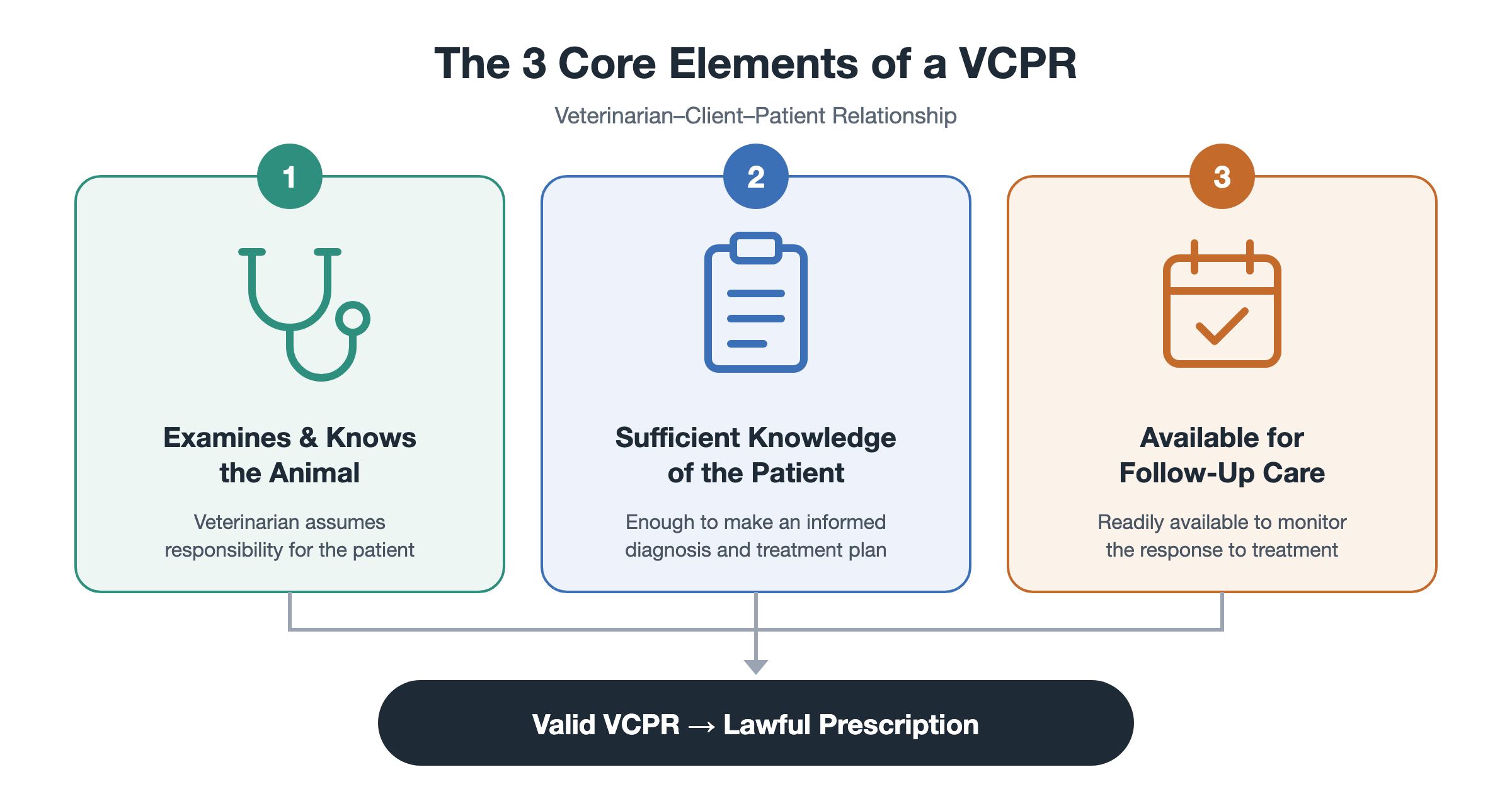
- The veterinarian examines and knows the animal. They take responsibility for clinical decisions about the patient, and the client agrees to follow their instructions.
- The veterinarian has sufficient knowledge of the patient. They know the animal well enough, through a recent exam or timely visits, to make an informed diagnosis and treatment plan.
- The veterinarian is readily available for follow-up care. They can monitor the response to treatment and step in if something goes wrong.
Why a refill or an online pharmacy request may need an exam
Picture a familiar situation in veterinary practice: a client calls for a medication refill, or an online pharmacy seeks authorization for a pet receiving long-term medication. The veterinarian reviews the chart and cannot approve it because the patient’s last examination is outdated. To the client, nothing has changed; legally, however, the VCPR may no longer be current.
A VCPR is not permanent. It expires when a veterinarian hasn’t examined an animal for a specific period of time. Its validity depends on the date of the last examination and the requirements of the state where the veterinarian is licensed. In many states, for example, a patient last examined more than a year ago needs another exam before a prescription can be authorized. This is why an appointment needs to happen before a veterinarian can safely and legally prescribe or approve a medication refill.
Veterinarians face heavy pressure to routinely approve prescriptions. Ultimately, however, the veterinarian’s own license is on the line. A pharmacy can only fill what a veterinarian authorizes; it cannot substitute for the lawful, established relationship required to issue that authorization.
Online pharmacies are not the problem here. Your clients use them, and your team already works with them every day. They require the exact same standard as your in-house pharmacy: a valid prescription backed by a current VCPR. The examination requirement doesn’t change based on where the medication is filled; it applies equally whether the product is handed over the counter or shipped directly to the client’s home.
For front-desk staff: check the last exam date against your state’s requirements before sending a refill request to the veterinarian. If the VCPR has lapsed, shift the conversation from “we can’t approve this” to “an exam is the next step, and here’s why.”
How states define it
Because there is no single standard definition of a VCPR, compliance rules vary significantly by state. Individual state practice acts and board regulations dictate how recently an animal must be examined to keep a VCPR active, and whether the relationship can be established virtually or requires an in-person visit.
Several states have also updated their laws recently, so older guidelines or practices learned in other jurisdictions may no longer be compliant. When in doubt, check your state veterinary medical board’s website for the current rules.
Your state veterinary medical board establishes and enforces the specific rules tied to your license. The AVMA, a professional association rather than a regulator, publishes helpful guidance, including how the VCPR applies to virtual care on its Telehealth and the VCPR page. Always verify AVMA summaries against your state board’s official text, since state law is what you are held to.
Federal rules also apply. According to the FDA, extra-label drug use in animals requires a valid VCPR. This federal requirement works alongside your state’s rules rather than replacing them. Even if a prescription satisfies state law, it must still comply with federal standards when it involves extra-label use.
A client-ready explanation to copy
Front-desk staff can save this as a Text Blaze snippet and use it in a portal message, email, or text, filling in the details each time. Because it does not specify a timeframe, it works regardless of your state’s requirements.
VCPR Refill Request Reply
Hi {formtext: name=client_name},
Thanks for your refill request for {formtext: name=pet_name}. Before we can approve {formtext: name=medication}, {formtext: name=veterinarian} needs to make sure {=pet_name} has been examined recently. This allows us to confirm that the medication is still safe and appropriate for your pet’s current health. The same requirement applies to prescriptions filled through online pharmacies.
Our records show that {=pet_name} was last examined on {formdate: MM/DD/YYYY; name=last exam date}, so the next step is a short {formmenu: recheck; default=wellness visit; name=type of visit}. You can reply here with a few dates and times that work for you. Once the exam is completed, we’ll review the refill request and take care of the prescription as soon as possible. We’d love to see {=pet_name} again!
Kind regards,
_
This message works well for two reasons. It keeps an inviting tone by asking the client to come in rather than refusing the refill. It also handles pushback upfront: if a client asks why they need to come in, the message already explains that the vet needs a current health assessment to safely prescribe medication.
Want to save hours of repetitive typing in your vet clinic for free?
Join over 800,000+ others who are using Text Blaze templates.
Save it as a snippet so the front desk sends the same words every time
A message like this goes out many times a week. Saving it as a snippet lets anyone in the clinic give clients a consistent and reliable response while saving time.
Text Blaze is a text-expansion tool. You save a template under a shortcut, such as /refill, then type the shortcut in any text field and the saved text appears on the spot. That works in an electronic health record, an email, a client portal, or a telehealth chat. It runs as a browser extension for Chrome and as a desktop app for Windows and Mac, and you can start on the free plan. The Text Blaze desktop app also works directly inside installed Windows practice software, such as Cornerstone, AVImark, or ImproMed.
A snippet can be plain text, or it can be a dynamic template. When you type the shortcut, a popup asks for the patient details that change each time, such as a drop-down choice, a date, or a few words, and the finished text is inserted with those details filled in.
In Text Blaze, you can also share a folder of snippets with your team, so everyone sends the same wording and your edits reach them right away. Text Blaze only stores the template wording, not the client or patient details you type into it.
Text Blaze is already used in veterinary clinics: State Road Animal Hospital saved over 1,000 hours by turning their repetitive messages and notes into snippets.
The free Veterinary Starter Kit includes this message along with other ready-to-use snippets. They work wherever your team already types: browser-based practice software, email, your texting platform, or a pharmacy portal. Copy the template, type the shortcut, enter the details for that client and pet, and the prepared message appears with the information filled in. For exam documentation, see our free veterinary SOAP note and physical exam templates.