
Nursing Narrative Note Templates

Eliminate repetitive typing and mistakes. Insert a skilled nursing narrative note in any text box in seconds.

Free forever. Works in any web-based EHR or app. No integration required.

4.9 · 1,900+ Chrome Web Store reviews · 800,000+ people use Text Blaze

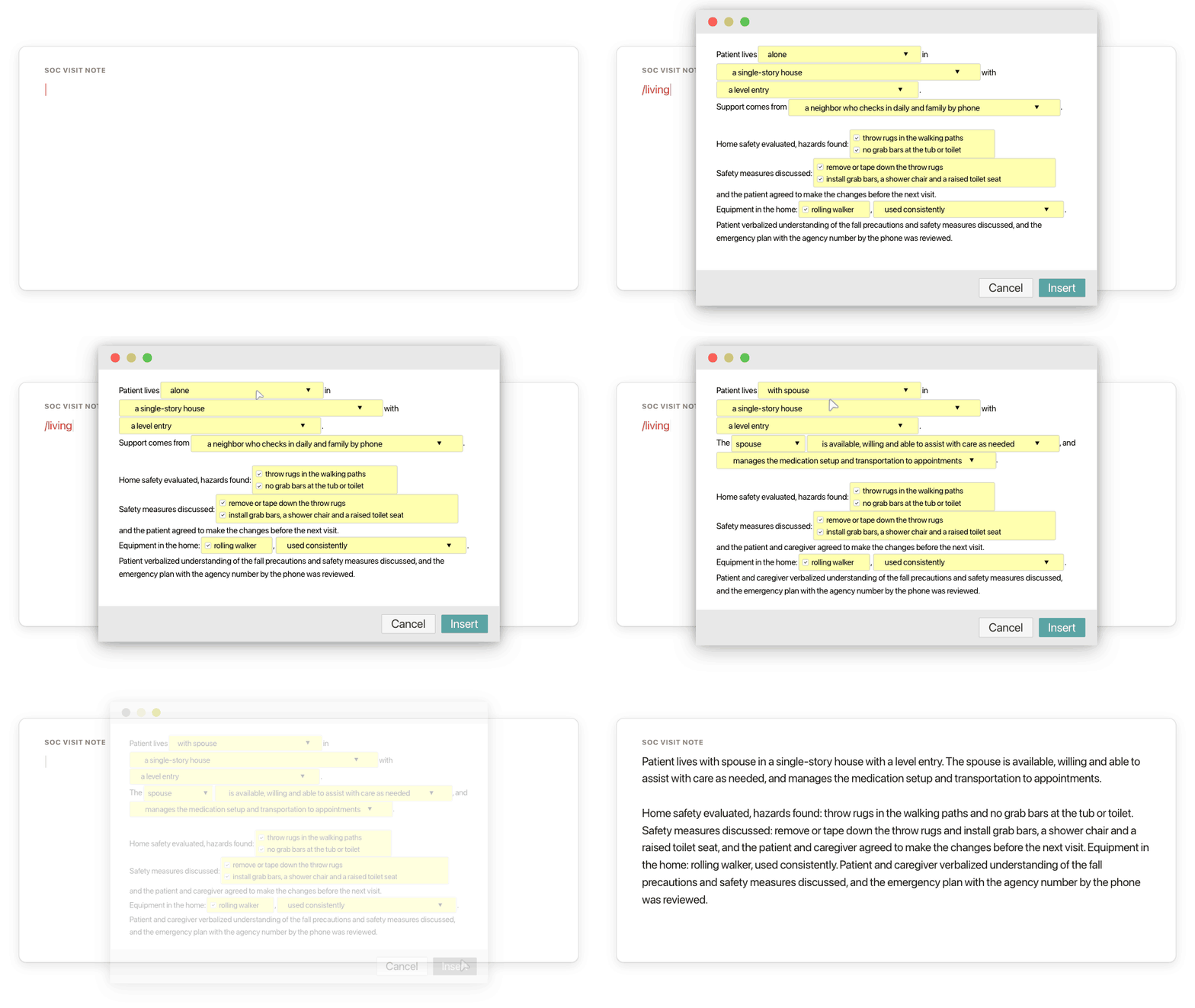
Typing /living opens the Text Blaze pop-up, the first menu changes from alone to with spouse and the caregiver lines appear, and Insert places the living situation narrative in the visit note

Type /living. Pick who is home. Insert.

  1. Add the packThe button opens the pack's page on the Text Blaze marketplace. Add the pack in one click (sign up for a free account if you do not have one) and the templates are yours, ready to edit and use anywhere.
  2. Type /living where you chartWith Text Blaze installed (the Chrome extension, or the Windows or Mac app), type /living in your EHR's narrative field, or in a Google Doc you draft in. A pop-up opens with menus for who the patient lives with, the home, the hazards you found and the equipment. For the whole visit, type /narr instead.
  3. Fill in, insert, editPick who the patient lives with and the caregiver sentences change to match. Choose the hazards and the safety measures you discussed, then insert. It lands as text you can still edit.
  4. Then make one of your ownCreate a snippet of sentences or paragraphs you type often. Give it a keyboard shortcut. Type the shortcut anywhere and the text appears. Congratulations! You just saved yourself a few seconds.

What is Text Blaze?

Text Blaze is a free Chrome extension, with Windows and Mac apps, that turns the text you type again and again into templates you insert with a shortcut. Type /narr and a whole skilled nursing narrative appears where your cursor is, in any app you type in on a computer.

Many home health nurses write their narratives in the evening, hours after the last visit, and type the same sentences each time. If you keep your phrases in a Word or Google Doc and paste from it, this is that document, one shortcut away inside the chart. Templates can hold text fields, drop-down menus and toggles, so the structure stays the same and the details are this patient's.

Works where you chart on a computer

The web versions of WellSky, Axxess and Alora, Google Docs, Gmail and Outlook. No integration to set up. On an agency laptop, IT may need to approve the extension first. Phone and tablet charting apps are the exception.

The same structure, your own words

Menus hold complete sentences you pick from, and text fields hold what you found and what the patient said or did. You write the details, the template keeps the order.

Your agency's wording, saved once

Change the menus once to the phrases your agency uses and every narrative starts from them. One person can set the templates and share the folder with the team. Sharing limits are on the plans page.

Free forever

/dischargeplan, /nochange and any snippet you save yourself without form fields are free forever. The eight snippets with form fields can be tested on the free plan and need Pro, $2.99 a month billed yearly, for day-to-day use. "Is the pack free?" below has the details.

Works in WellSky (web)Axxess (web)Alora (web)GmailOutlook on the webGoogle Docs

Template insertion is done locally. PHI and other sensitive information never leaves your computer.

What is a nursing narrative note?

A nursing narrative note is the part of the record written in full sentences: what you found, what you did, and how the patient responded, usually in the order it happened. In home health it also carries the homebound status, the skilled need and the plan for the next visit.

Most home health visit notes mix checkboxes and a narrative field. The checkboxes record the assessment. The narrative is where you explain it: why this visit needed a nurse, what changed since the last one, and what happens next. A narrative nursing note is written:

  • For every routine visit, as the summary of the skilled service and the patient's response.
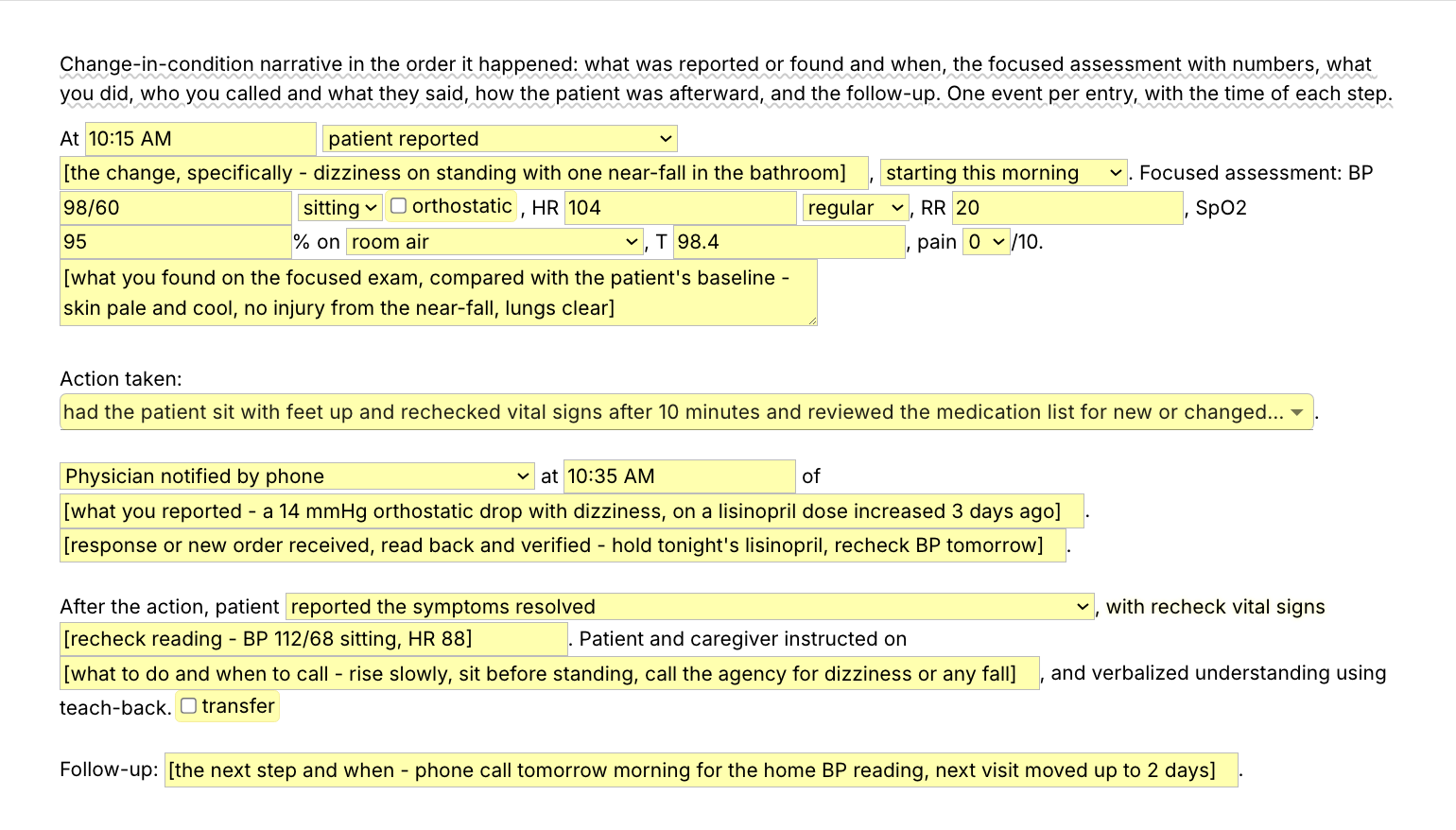
  • When the patient's condition changes, as an event note in time order: what was reported or found and when, what you did, who you called and what they said, and how the patient was afterward.
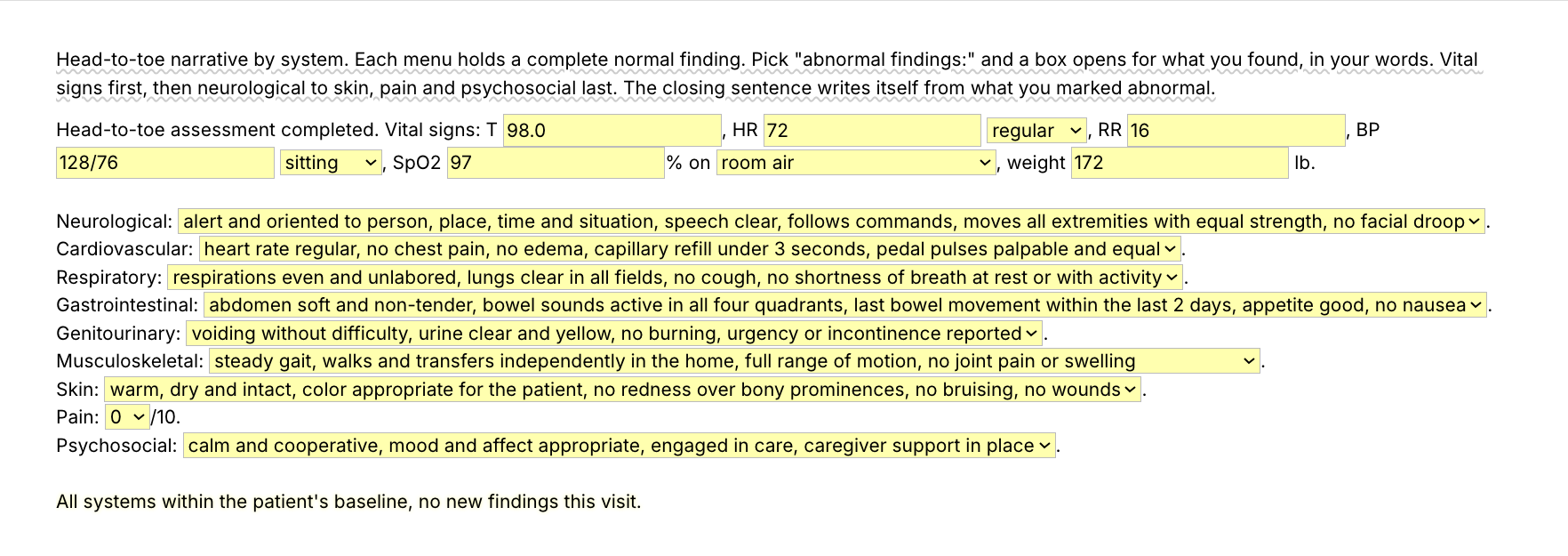
  • For a head-to-toe assessment, system by system, when a normal finding needs to be written out and an abnormal one needs detail.
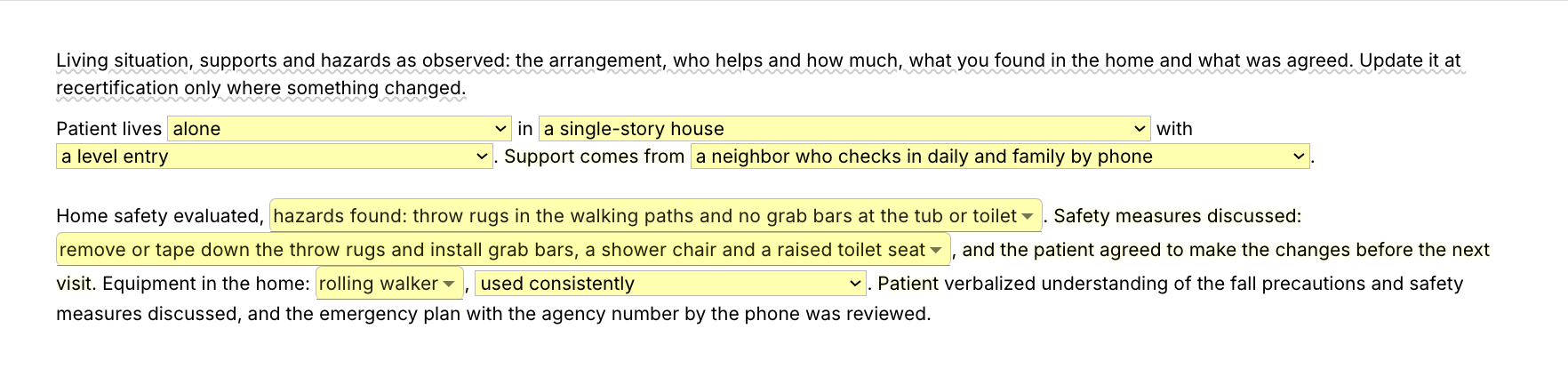
  • For the home, at the start of care and when something changes: who the patient lives with, who helps, the hazards and the equipment.

A narrative is different from a SOAP or DAR note, which split the same facts under fixed headings. Many agencies use both: headings or checkboxes in the visit form, and a narrative where the form leaves a free-text field.

How to write a nursing narrative note

A good nursing narrative note is specific and in order. It gives numbers instead of conclusions, compares them with the last visit, names the skilled service and the teaching, and records the patient's response as what the patient did or said. It ends with the plan for the next visit.

  • Measured, not summarized. "Weight 188 lb, 184 lb at the last visit, 2+ pitting edema to mid-calf" is a finding. "Some swelling" is not.
  • The skilled service named. What only a nurse could do at this visit: assessment of a specific system, teaching, medication management, a procedure, tied to the plan of care.
  • The patient's response, observed. "Restated the low-sodium diet using teach-back" shows the teaching worked. "Tolerated well" alone does not.
  • Physician contact in full. Who was notified, how and when, what you reported, and the response or new order, read back and verified.
  • Homebound and skilled need from today's findings. The reason leaving home is a considerable and taxing effort, and why skilled nursing is still needed now.
  • A plan for the next visit. What you will recheck and when the next visit is.
  • Late entries labeled. A note written after the visit says so, with the date and time the care was given.

What the template types and what you type

The order of a narrative and many of its sentences are the same from visit to visit. The findings and the response are not. The pack splits the two: the structure and the sentences you repeat are typed for you, and text fields are left for what you saw and what the patient said. /dischargeplan is the shortest one: the discharge planning sentence most visits need, with no form fields. A good first one to change into your own words.

Check the wording against your agency's documentation policies, and change it once where they differ.

How this template helps

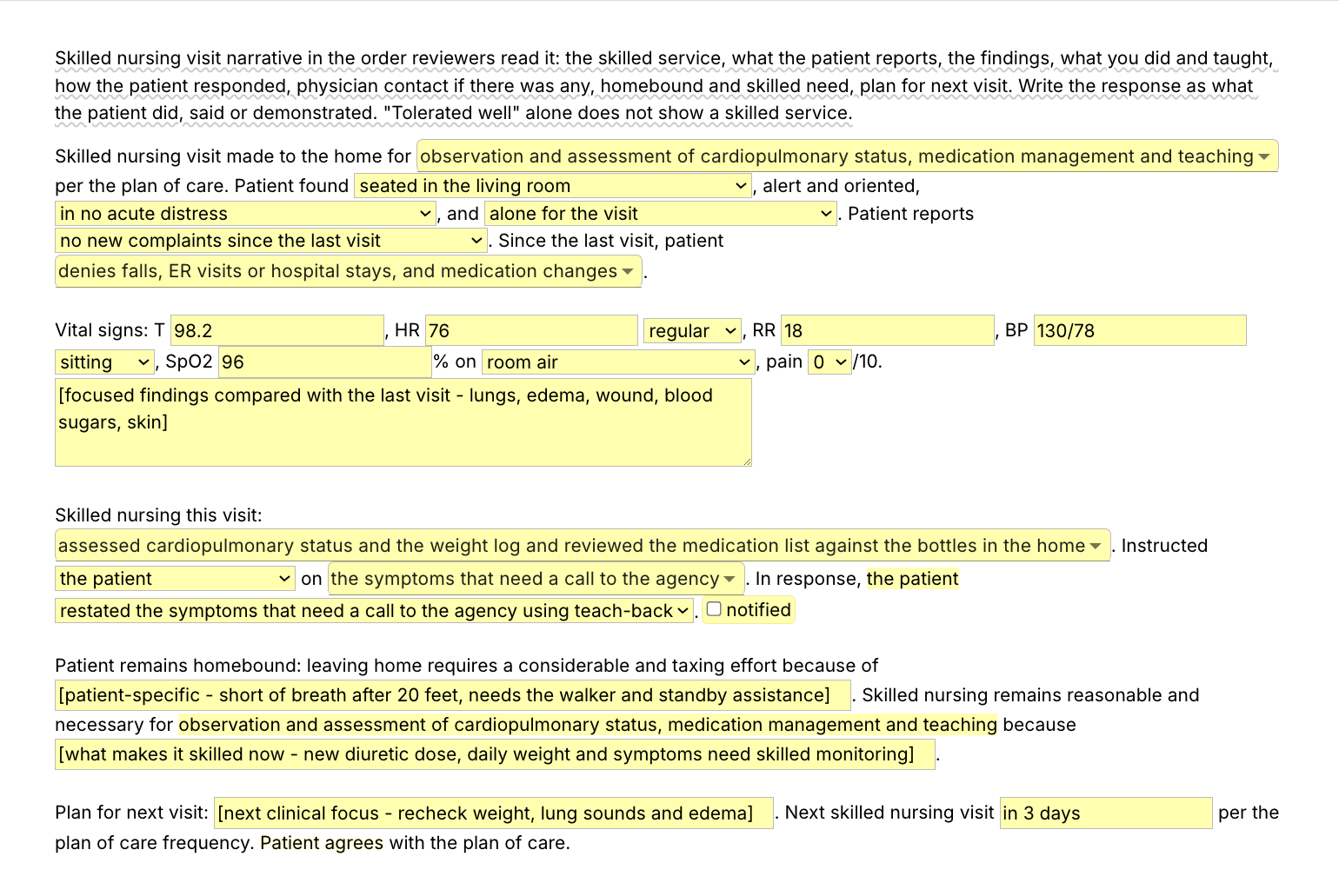
The /narr snippet is a skilled nursing narrative note as a Text Blaze pop-up: the skilled service, what the patient reports, vital signs and findings, what you did and taught, the patient's response, physician contact, homebound status, skilled need and the plan for next visit. You pick from menus and type what you assessed. Three more templates and six shorter snippets cover the rest.

Inside the pop-up

The first screenshot at the top of the page is the whole form. Menus hold the choices you make at most visits: the skilled service, where you found the patient, who was there, the since-last-visit check, the skilled nursing you did, who you taught and what, and how they responded. Text fields hold the vital signs, your findings, the homebound reason, why the visit was skilled and the next clinical focus. A toggle adds the physician notification paragraph when you called. The guidance note at the top shows while you write and is never inserted.

A nursing narrative note example

Here is a narrative nursing note example: what /narr inserts, filled in for a fictional patient with heart failure.

Skilled nursing visit made to the home for observation and assessment of cardiopulmonary status, medication management and teaching per the plan of care. Patient found resting in bed, alert and oriented, short of breath with talking, and with the caregiver present for the visit. Patient reports new or worsening symptoms since the last visit: more shortness of breath on the stairs and both ankles bigger since Sunday. Since the last visit, patient denies falls and ER visits or hospital stays.

Vital signs: T 98.4, HR 92 irregular, RR 22, BP 146/88 sitting, SpO2 92% on room air, pain 2/10 in both ankles. Crackles in both lung bases, 2+ pitting edema to mid-calf on both legs, weight 188 lb (184 lb at the last visit). Sleeping on two pillows, no chest pain.

Skilled nursing this visit: assessed cardiopulmonary status and the weight log and reviewed the medication list against the bottles in the home. Instructed the patient and caregiver on the symptoms that need a call to the agency. In response, the patient and caregiver restated the symptoms that need a call to the agency using teach-back.

Physician notified by phone of the 4 lb weight gain since the last visit, crackles in both lung bases, 2+ edema to mid-calf, SpO2 92% on room air, RR 22, a new irregular heart rhythm and sleeping on two pillows. New order received for furosemide 40 mg twice daily for 3 days, then back to 40 mg once daily, a BMP in 2 days, and ER evaluation for chest pain, worsening shortness of breath or SpO2 below 90%, read back and verified. Patient and caregiver informed of the plan.

Patient remains homebound: leaving home requires a considerable and taxing effort because of shortness of breath after 20 feet and the need for a rolling walker and standby assistance to leave the home. Skilled nursing remains reasonable and necessary for observation and assessment of cardiopulmonary status, medication management and teaching because the diuretic dose changed today and daily weight, lung sounds and edema need skilled monitoring for the response.

Plan for next visit: recheck weight, lung sounds and edema after the diuretic change and draw the ordered BMP. Next skilled nursing visit in 2 days (PRN) per the plan of care frequency. Patient and caregiver agree with the plan of care.

To write it, five menus were changed, the physician paragraph was switched on, and the vital signs, findings, report, order and plan were typed over the samples. Every text field opens with a sample value, so type over each one at every visit.

The other three templates

  • /event, the change in condition narrative, in time order: when it happened and who reported it, the focused assessment with an orthostatic toggle, the action taken (choose several), who was notified and when, what you reported and the order received, how the patient was afterward with the recheck reading, the teaching, a transfer toggle and the follow-up.
  • /h2t, the head-to-toe assessment narrative: vital signs and weight, then one menu per system, each holding a complete normal finding. Pick "abnormal findings:" and a text field opens for what you found. The closing sentence changes to match: all systems within the patient's baseline, or the abnormal findings addressed in the plan of care.
  • /living, the living situation and hazards narrative: who the patient lives with and the home, the caregiver's availability and help (or the support for a patient who lives alone), the hazards found, the safety measures discussed and the equipment in the home.

Shorter snippets for the sentences you type most

  • /dischargeplan, the per-visit discharge planning sentence. It has no fields, so it works on the free plan without limit.
  • /nochange, the since-last-visit sentence for a routine visit: no new complaints, falls, ER visits, hospital stays or medication changes. No fields either.
  • /arrived, the opening sentence, with a menu for where you found the patient.
  • /medupdate, the medication change paragraph, with fields for what changed and who ordered it, and the teaching and the patient's response.
  • /lateentry, the late entry line, with the date and time of the visit.
  • /coord, the care coordination sentence, with a menu for the discipline or office role and a field for what you discussed.

Text Blaze helps me finish my paperwork while I'm still sitting with a patient.

Stephanie Yakobina

Add the pack to a free Text Blaze account and type /narr in your next visit note.

Copy the template for free

Free forever. Works in any web-based EHR or app. No integration required.

Questions home health nurses ask

Do I need Text Blaze to use this template?

Yes. The templates are Text Blaze snippets. The free plan is enough to add all 10, to use /dischargeplan, /nochange and any snippet you make that has no form fields as often as you like, and to test the templates with form fields. Text Blaze is a free Chrome extension, with Windows and Mac apps as well.

Does it work in my EHR?

Yes. Text Blaze works in your EHR, your email and any other app you use on a computer: the web versions of WellSky, Axxess and Alora among others, Gmail, Outlook and Google Docs. If your EHR opens in Chrome or Microsoft Edge, or runs as a Windows or Mac program, Text Blaze works there. There is nothing to integrate: you type the shortcut in the field where you would have typed the narrative. It does not run inside phone or tablet charting apps, so a visit charted on a tablet stays hand-typed there. That includes the Homecare Homebase field app, which runs on Android phones and tablets.

To check yours, add the pack and type /nochange in a narrative field on your computer. If the sentence appears, the rest will too. On an agency computer, IT may need to approve the Chrome extension or the Windows app before you can install it.

My EHR already has templates. Why this pack?

Keep them if they work for you. The pack is for the free-text narrative those templates leave to you, and for the sentences you keep in a document and paste. It works the same in a second system or a Google Doc, and it comes with you if your agency changes EHRs.

Will my notes look cloned?

Not if the findings are this visit's. The structure repeats because every narrative needs the same parts. What makes notes read as cloned is the same findings, the same response and the same homebound reason carried forward. In /narr, the vital signs, the findings, the homebound reason and why the visit was skilled are text fields that open with sample values, so you type over them at every visit, and the response menu asks what the patient did or said. In /event, every reading, finding and order is a text field. Read what you inserted before you sign and change anything that differed.

Is my patient's information stored anywhere?

Text Blaze snippets hold your template and your defaults, not your patient records. Template insertion is done locally: what you type into the pop-up's fields goes into the page you are on and is not saved, synced or logged by Text Blaze after you insert.

BAA is available upon request. Read our HIPAA guide.

Is the pack free?

The pack is free to add, and its 10 snippets fit the free plan. /dischargeplan and /nochange are free to use forever, and so is any snippet you save yourself without form fields. On the free plan you can test the eight snippets with form fields (the four templates, /arrived, /medupdate, /lateentry and /coord) to see how they work. Using them day to day needs Pro, $2.99 a month billed yearly ($3.49 billed monthly). The plans page lists what each plan includes.

Can I change the template?

Yes. Everything is editable: the menu options, the defaults, the sentence frames and the order. Add the skilled services your agency sees most to the /narr menu, put your own normal findings in the /h2t menus, or add the hazards you find most often to /living. Change it once and it stays changed.

Does the template guarantee reimbursement?

No. Coverage depends on the patient meeting the criteria and on the record showing it. The pack gives you the parts of a narrative in a consistent order and leaves room for the findings. It cannot supply the findings, and the wording should be checked against your agency's policies.

Can I use it on Windows or Mac?

Yes. Text Blaze runs as a Chrome extension (it installs in Microsoft Edge too) and as Windows and Mac apps, so the shortcuts work in web-based EHRs and in desktop apps alike, with the same snippets on every computer you sign in on. There is no iPad or phone app, so a note written in a phone or tablet charting app stays hand-typed.

Narratives done before dinner.

Add the free narrative pack and set the menus to your agency's wording once. Each narrative takes minutes, and /dischargeplan puts the discharge planning sentence into any note with one shortcut.

Copy the template for free

Free forever. Works in any web-based EHR or app. No integration required.